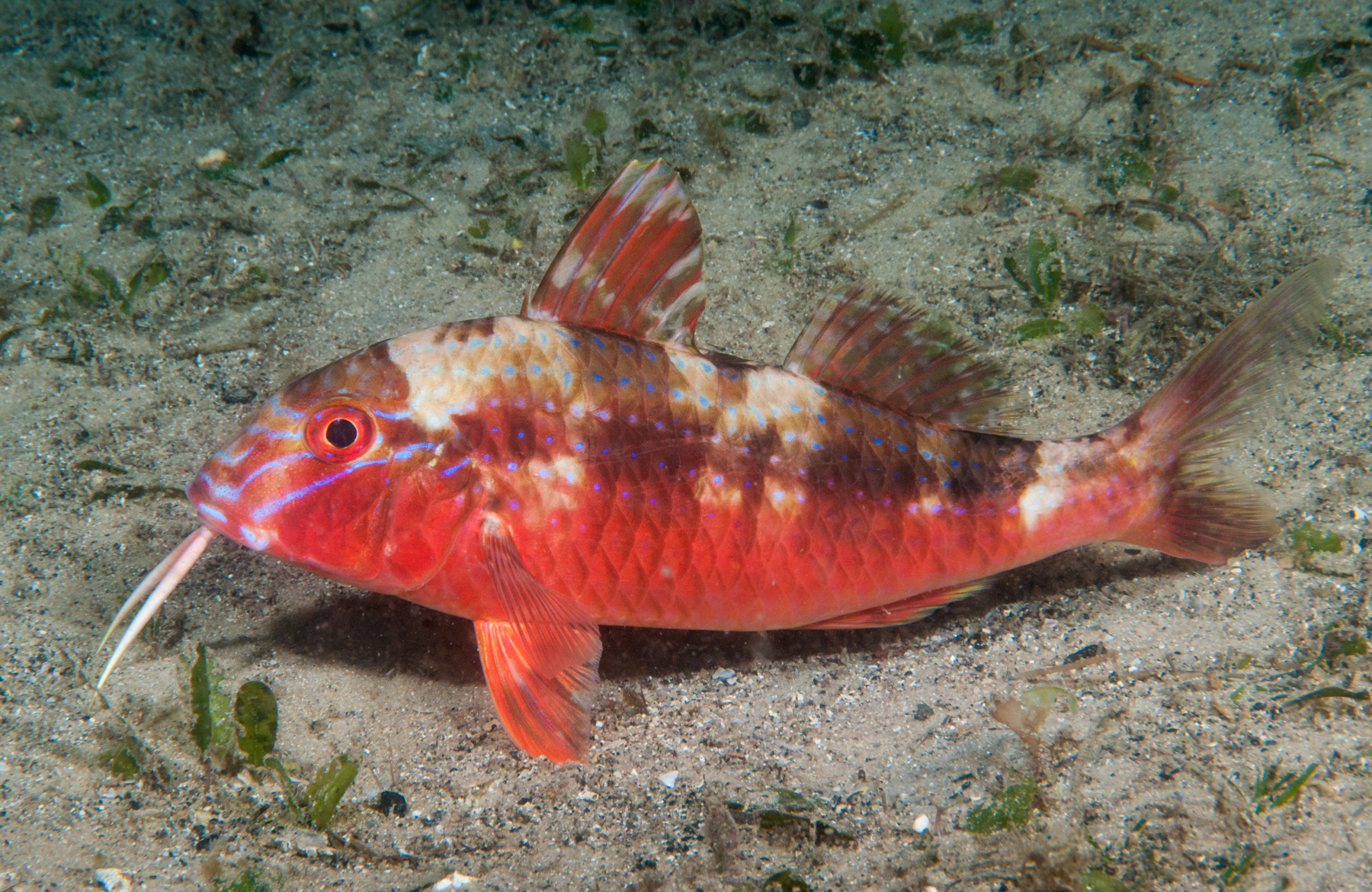
Bluestriped Goatfish vary greatly in colour from almost white to a deep red, with an orange to reddish-brown stripe and lines of blue dots along the sides, and often other blotches and markings. They have a distinct midlateral stripe, and yellow stripes on the dorsal fin|dorsal and anal fins.
Goatfish use their sensory chin barbels to probe the sediment on search of prey.
Very similar to and often confused with the Bluespotted Goatfish, (Upeneichthys vlamingii), which has a slightly longer head and the midlateral stripe is not as distinct.
Sorry I am working on providing identification images and information for this species please check back soon
What habitats does Upeneichthys lineatus live in?
Sandy bottoms in sheltered waters such as in bays and harbours
What is the distribution of Upeneichthys lineatus?
Eastern and southeastern Australia including around Tasmania
How big does Upeneichthys lineatus grow?
Can grow to around 40cm

This does not mean that it cannot be found locally, just that I have not been able to verify records at the time this species was added to the database.
Disclaimer: A lot of work goes into trying to identify and ensure accurate identifications are made and that the listed Descriptions, Sizes, Habitats and Distribution information is as accurate and valid as possible. Unfortunately, information in this arena is ever changing and as such no guarantee can be offered that it is correct or currently valid as a result the information is provided as a guide, and it is always suggested that you do a little research to ensure you have the latest and most accurate information. View the reference's or bibliography I welcome any feedback and comments on the information provided.